WHAT IS A CHAIN DRIVEN LIVE ROLLER CONVEYOR?
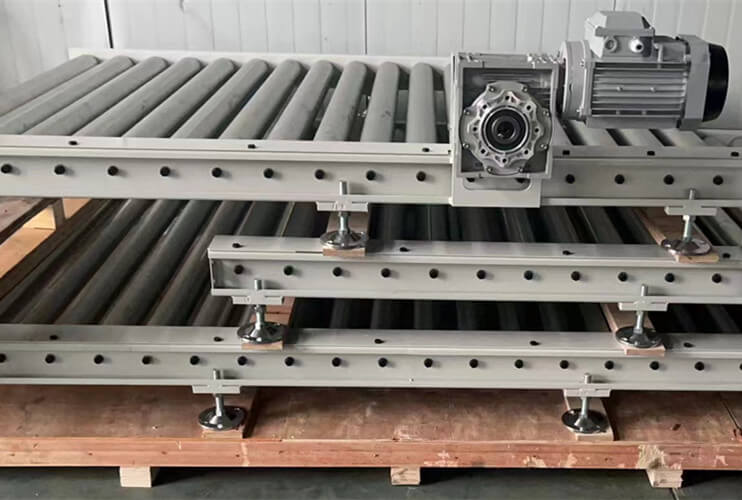
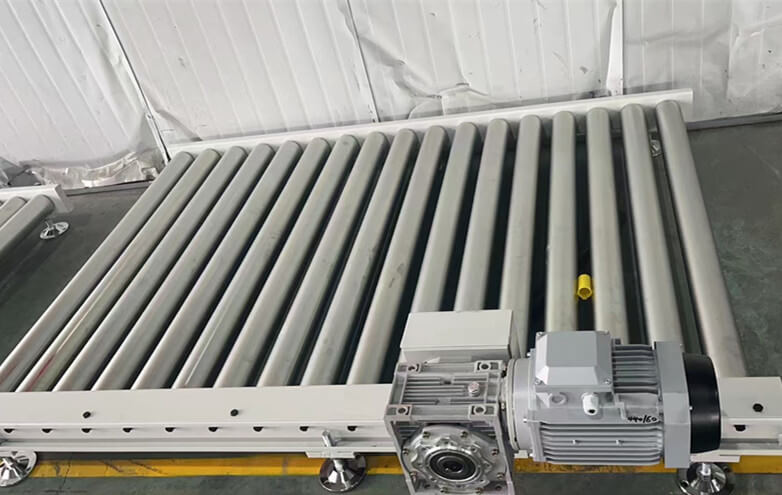
A Chain-Driven Live Roller (CDLR) conveyor is a type of heavy-duty material handling equipment where each load-bearing roller is powered via a continuous roller chain. Unlike MDR, belt-driven, or gravity conveyors, CDLR systems use a drive chain that loops around sprockets attached to every roller. This chain is driven by a motorized pulley, transmitting positive, slip-free rotation to all rollers simultaneously.
In a typical CDLR design, the chain runs beneath the roller bed, engaging sprockets on each roller shaft. The rollers are usually steel or heavy-gauge aluminum, with diameters ranging from 1.9 to 3.5 inches or more. The chain drive ensures that every roller turns at the same speed, providing uniform movement for pallets, drums, steel coils, or heavy plastic bins. CDLR conveyors are available in straight sections, curves, and even incline/decline configurations, making them highly versatile for industrial environments.
CDLR CONVEYOR ENABLES ACCUMULATION OF PRODUCT
One of the most valuable features of a CDLR conveyor is its ability to accumulate products without causing damage or excessive wear. Accumulation means that items can be stopped and held on the conveyor while the drive chain continues to run beneath them. This is achieved through a unique “slip” mechanism. When a stop gate or photo-eye sensor holds back a pallet or container, the rollers continue to turn underneath it, but the load remains stationary due to low-friction contact between the roller surface and the pallet bottom.
This is possible because CDLR rollers are not permanently fixed to the chain; they are driven by sprockets that allow a controlled amount of slippage when backpressure builds up. Zero-pressure accumulation zones can be created by using multiple drive sections with independent motors or clutch/brake modules. This permits products to queue smoothly during sorting, packaging, or palletizing operations. Accumulation reduces impact forces, minimizes product jams, and protects both the load and the conveyor structure from shock loads. It also enables continuous upstream production even when downstream processes are temporarily halted, significantly improving overall system throughput and efficiency.
Roller-Chain-Conveyor
WHY USE CDLR / PALLET ROLLER CONVEYORS?
CDLR conveyors are the preferred solution for many heavy-load and demanding applications for several compelling reasons:
First, durability and load capacity. CDLR systems can handle loads from a few hundred pounds up to several tons per pallet. The rugged chain-and-sprocket drive is immune to belt stretching, slipping, or tracking issues, ensuring reliable performance in foundries, automotive plants, and warehouse distribution centers.
Second, positive drive control. Because the chain drives every roller mechanically, there is no reliance on friction between the belt and roller. This guarantees consistent speed even in wet, oily, or dusty conditions where belt drives would fail. Acceleration and deceleration are precise, which is critical for automated assembly lines and robotic pick stations.
Third, low maintenance and long service life. CDLR conveyors use heavy-duty sealed bearings and wear-resistant chain, requiring only periodic lubrication and tension adjustments. The robust construction reduces downtime and lowers total cost of ownership over years of continuous operation.
Fourth, flexible accumulation and zoning. As described earlier, the ability to accumulate without stopping the drive motor allows for efficient buffering between process stages. This reduces labor costs and minimizes product damage.
Finally, customization. CDLR conveyors can be engineered with different roller centers, chain pitches, and drive positions to fit specific footprint and speed requirements. Options include bi-directional travel, transfer cars, turntables, and integration with scales or stretch-wrappers.
In summary, CDLR conveyors combine strength, precision, and intelligent accumulation, making them indispensable for modern heavy-duty material flow. Whether moving engine blocks, chemical drums, or palletized goods, they deliver unmatched reliability and productivity in the harshest industrial settings.